Base Rate Fallacy in Leadership: When Stories Lie to Us
Updated: May 16
The Setup
A hiring manager interviews a candidate. He's articulate. Charismatic. Tells a compelling story about turning around a failing department.
She's impressed.
She hires him on the spot.
Six months later? He's underperforming. The team is in disarray. And she's quietly asking herself the question every leader eventually asks...
How did I get this so wrong?
She ignored the base rate.
What the Base Rate Fallacy in Leadership Actually Is
The base rate fallacy — also called base rate neglect — is the tendency to ignore general statistical information in favor of vivid, individual-level information.
Daniel Kahneman and Amos Tversky introduced it in a 1973 study titled On the Psychology of Prediction, published in Psychological Review. Participants got statistical base rates about two groups. Then personality descriptions. Then they were asked to judge.
Almost every time... they ignored the statistics. They went with the vibes.
The vivid description won. The math lost.
In their now-famous cab problem, participants were told 85 percent of cabs in a city were green and 15 percent were blue. A witness — accurate 80 percent of the time — identified a cab in an accident as blue.
Most people said the cab was probably blue.
Run the actual Bayesian math? There's only about a 41 percent chance the cab was blue. The base rate of green cabs swallows the witness testimony.
But the brain doesn't naturally do Bayes.
The brain does stories.
And as my grandmother would've said... that right there is the whole problem.
Why This Matters for Leadership, Bias, and Belonging
Every leader makes decisions based on leadership instincts, impressions, interviews, and individual cases — not statistical patterns. Which means base rate neglect is not a niche cognitive quirk. It's the operating system of most executive decision-making.
And it shows up everywhere — including in how organizations approach bias, belonging, and organizational culture work.
A company hears one viral story about a "successful" DEI training and adopts the same model nationally. The base rate of single-session bias training effectiveness? Meta-analysis tells us most don't produce sustained behavioral change (Bezrukova et al., 2016, Psychological Bulletin).
A leader fires one underperforming employee from a particular background and quietly stops hiring people from that background. One vivid story. A lifetime of statistical reality overwritten in an afternoon.
This is how the base rate fallacy turns into bias.
This is how bias gets dressed up as "experience."
Where the Base Rate Fallacy Lives
Three crystal-clear illustrations.
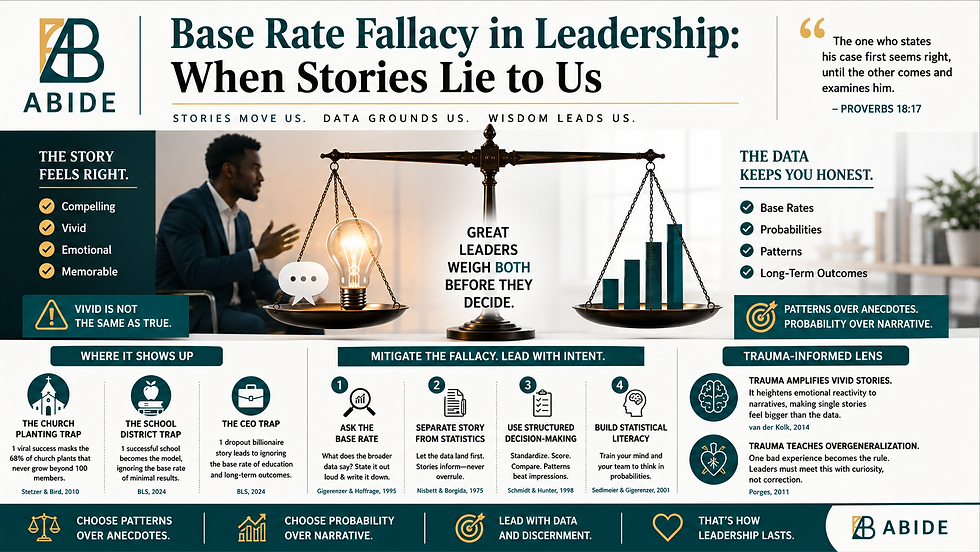
The church planting trap. A church planting organization celebrates a viral testimony from a church that grew from 50 to 500 members in two years. They overhaul their entire training model to replicate that approach.
What they ignore? The 2007 North American Mission Board multidenominational study found that 68 percent of church plants are still operating four years after launch — and the vast majority of survivors never break 100 members (Stetzer & Bird, Viral Churches, 2010). One spectacular story overrode a mountain of statistical reality. The new model fails most places it lands.
The school district trap. A district reads about one innovative charter school that raised test scores with a particular curriculum. They spend millions adopting it across 40 schools. The base rate? Most schools using that same curriculum showed negligible improvement. The charter's results were a statistical outlier. But outliers tell better stories than averages.
The CEO trap. A CEO reads about a college dropout who built a billion-dollar company. He starts undervaluing formal education in hiring. The base rate of self-made billionaire dropouts is statistically rare; college completion still correlates with significantly higher lifetime earnings and psychology of leadership outcomes across virtually every measured industry (Bureau of Labor Statistics, 2024).
In every case, the leader wasn't unintelligent. The leader was human.
Kahneman called this the representativeness heuristic — judging situations by how well they match a vivid prototype rather than by actual probabilities (Kahneman, 2011, Thinking, Fast and Slow).
In plain English? The brain is allergic to math when there's a good story in the room.
Faith and Leadership: Wisdom Already Knew This
Here's where it gets interesting.
Long before behavioral economics had a name, faith and leadership traditions were already pushing back on single-case reasoning.
Proverbs 18:17 — "The one who states his case first seems right, until the other comes and examines him."
That's a base rate warning. Don't decide on the first vivid testimony. Wait for the broader pattern.
Ecclesiastes 7:10 — "Say not, 'Why were the former days better than these?' For it is not from wisdom that you ask this."
That's a base rate warning too. Don't let one golden memory rewrite the actual statistical history of "the good old days." Nostalgia is just survivorship bias wearing cologne.
The Stoics knew it. Marcus Aurelius wrote in Meditations (Book 7) about training the mind to see "the nature of the whole" rather than being captured by single impressions. That's pattern-thinking. That's base rate discipline. In a toga.
The wisdom traditions weren't anti-story. They were anti-only story.
Trauma-Informed Lens
Here's where this gets personal.
Trauma amplifies the base rate fallacy in two distinct ways.
First, trauma heightens emotional reactivity to vivid narratives. People with unresolved trauma are neurologically primed to respond to stories — especially stories of suffering, redemption, or crisis. The amygdala is already sensitized. A single vivid story can hijack decision-making in ways that override all statistical reasoning (van der Kolk, 2014, The Body Keeps the Score).
Second, trauma teaches generalization from single events. A child harmed once by a trusted adult may learn that all authority figures are dangerous. An employee fired without warning may decide every workplace is unstable. These are base rate violations encoded in the nervous system. The traumatized brain learned to survive by overgeneralizing — applying one vivid experience universally, ignoring the statistical reality that most authority figures are safe and most workplaces are stable (Porges, 2011, The Polyvagal Theory).
For trauma-informed leaders, this means two things.
One. Your own trauma history may be biasing your decisions toward vivid cases over base rates. The "gut feeling" you trust so much? Sometimes it's wisdom. Sometimes it's an old wound running the meeting.
Two. When you lead people with trauma histories, their resistance to statistical reasoning isn't intellectual stubbornness. It's a nervous system that learned safety by overgeneralizing. Meet that with curiosity. Not correction.
What the Research Says About Mitigation
Good news. The base rate fallacy in leadership responds to intentional practice. The brain can be retrained. Neuroplasticity is real, and it's stubbornly hopeful.
1. Ask the question. Out loud. Every time.
Before any major decision, pause and ask: What is the base rate?
What does the broader data say about success rates for this type of hire, program, initiative, investment?
Gigerenzer and Hoffrage (1995, Psychological Review) showed that presenting statistical information as natural frequencies — "12 out of 100" — instead of percentages dramatically improves base rate usage.
Practical shift: Before your next major decision, research the base rate of success for similar initiatives. Write it on the whiteboard before the discussion starts. Let it stare at you the whole meeting.
2. Separate the story from the statistics.
Nisbett and Borgida (1975, Journal of Personality and Social Psychology) demonstrated that even when participants had clear base rate information, one vivid case study was enough to override it.
The fix? Structurally separate them in your decision processes.
Practical shift: When evaluating proposals, create two distinct phases. Phase one — review the data and base rates. Phase two — hear the stories. Never let the story arrive before the math has had time to land.
3. Use structured decision-making frameworks.
Schmidt and Hunter (1998, Psychological Bulletin) ran a meta-analysis spanning 85 years of research. Structured interviews predict job performance dramatically better than unstructured ones. Why? Structure forces attention to patterns over impressions.
Practical shift: Standardized rubrics for hiring, promotion, and program evaluation. Weight base rate data alongside individual case information. Make the structure non-negotiable.
4. Build statistical literacy as a leadership competency.
Sedlmeier and Gigerenzer (2001, Journal of Experimental Psychology: General) showed that training people to think in natural frequencies significantly improved base rate reasoning.
Statistical literacy is not just for analysts.
It's a leadership skill.
Practical shift: Include basic statistical reasoning in your leadership development programs. Train your team to ask "What is the base rate?" with the same reflex they use for "What's the budget?"
The Leadership Call
Stories move us.
Data grounds us.
Effective leaders need both.
The base rate fallacy doesn't mean abandon stories. It means never let a single story replace the broader pattern. The most compelling testimony in the room should complement the data — not override it.
When a leader ignores base rates, they're not being visionary.
They're being statistically reckless.
And the people who pay the price? The teams. The organizations. The communities that bear the consequences of decisions built on beautiful stories and broken math.
So the next time someone walks in with a spectacular case study, an inspiring testimony, or a single data point that feels like a mandate... pause.
Ask the uncomfortable question.
What is the base rate?
What happens to most people, most organizations, most initiatives in this category?
That question won't make you less inspiring.
It will make you more trustworthy.
Choose patterns over anecdotes.
Choose probability over narrative.
That's how leaders make decisions that hold up long after the story fades.
References
Bezrukova, K., Spell, C. S., Perry, J. L., & Jehn, K. A. (2016). A meta-analytical integration of over 40 years of research on diversity training evaluation. Psychological Bulletin, 142(11), 1227–1274. https://doi.org/10.1037/bul0000067
Gigerenzer, G., & Hoffrage, U. (1995). How to improve Bayesian reasoning without instruction: Frequency formats. Psychological Review, 102(4), 684–704. https://doi.org/10.1037/0033-295X.102.4.684
Kahneman, D. (2011). Thinking, Fast and Slow. Farrar, Straus and Giroux.
Kahneman, D., & Tversky, A. (1973). On the psychology of prediction. Psychological Review, 80(4), 237–251. https://doi.org/10.1037/h0034747
Nisbett, R. E., & Borgida, E. (1975). Attribution and the psychology of prediction. Journal of Personality and Social Psychology, 32(5), 932–943. https://doi.org/10.1037/0022-3537.32.5.932
Porges, S. W. (2011). The Polyvagal Theory: Neurophysiological Foundations of Emotions, Attachment, Communication, and Self-Regulation. W. W. Norton & Company.
Schmidt, F. L., & Hunter, J. E. (1998). The validity and utility of selection methods in personnel psychology: Practical and theoretical implications of 85 years of research findings. Psychological Bulletin, 124(2), 262–274. https://doi.org/10.1037/0033-2909.124.2.262
Sedlmeier, P., & Gigerenzer, G. (2001). Teaching Bayesian reasoning in less than two hours. Journal of Experimental Psychology: General, 130(3), 380–400. https://doi.org/10.1037/0096-3445.130.3.380
Stetzer, E., & Bird, W. (2010). Viral Churches: Helping Church Planters Become Movement Makers. Jossey-Bass.
van der Kolk, B. A. (2014). The Body Keeps the Score: Brain, Mind, and Body in the Healing of Trauma. Viking.


Comments